Shotaology

Shota research

  • About
Kokoro Button: Kasuga-san and Kōga-kun! ココロ・ボタン

Call me by my first name: Intimate transgressions in Kokoro Button

2024-05-31 by Karl Leave a Comment

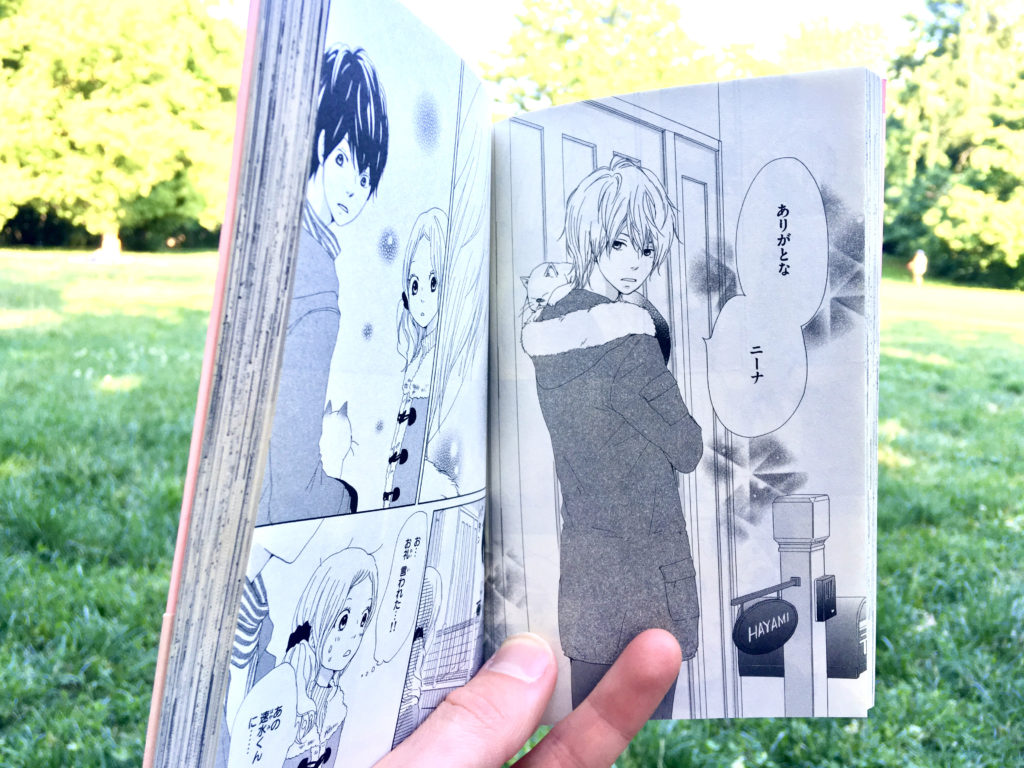
Kasuga Nīna is the protagonist of Usami Maki-sensei’s shōjo manga Kokoro Button. She’s dating Kōga Eito. In chapter 25, in tankōbon volume 6 from 2011, Kasuga-san has helped Kōga-kun’s friend Hayami Manabu to find his lost cat. The chapter ends with Hayami-kun thanking Kasuga-san with the words:

Thanks, Nīna
ありがとな ニーナ

Kokoro Button, vol. 6, p. 78

The impact of this phrase shakes the protagonist and her date to the extent that it will dominate the whole next chapter.

Crash course in Japanese name suffixes

To understand why, we must dive into the subtle art of how names are used in Japan to signal distance or intimacy:

  • The suffix -san is the neutral form that anyone can use, as in Kasuga-san.
  • The suffix -kun is used for boys and younger men, but also for male subordinates. It implies a somewhat affectionate relation.
  • The suffix -chan is used for girls and younger women in an affectionate way.
  • If the suffix is added to the first name, it’s more intimate than when it’s added to the family name.
  • The most intimate thing of all is first name and no suffix at all!

This is just a rough overview, the complexities of how suffixes are used, and by whom, is a subject in itself that you will have to read up on elsewhere. Suffice it to say that when Hayami-kun both drops the suffix and calls Kasuga-san by her first name it signals an intimacy that threatens the relationship between Kasuga-san and Kōga-kun, as if Hayami-kun had “had” Kasuga-san!

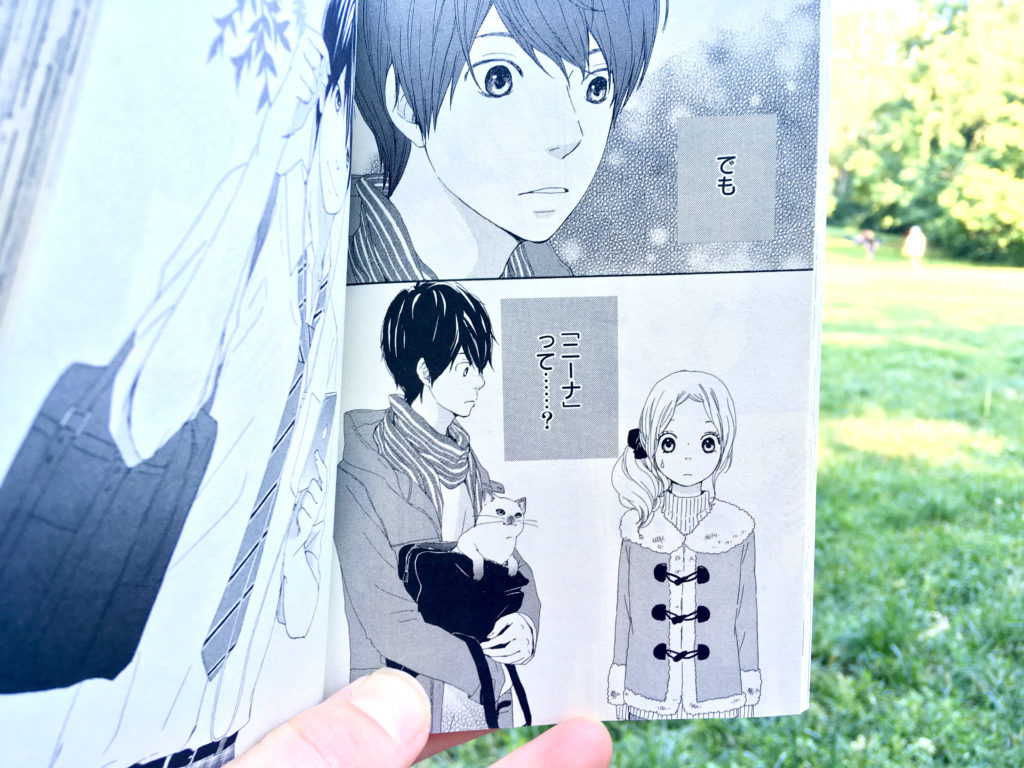
Hayami-kun calling Kasuga-san by her first name Nīna, leaving her and her boyfriend Kōga-kun in embarrassed shock!

It’s telling that Kasuga-san’s and Kōga-kun’s stunned reaction is the very last frame of the chapter, Kōga-kun looking at his girlfriend, maybe both questioning her and accusing her. This is a cliffhanger supreme for a series that was originally published in the monthly magazine Betsucomi.

My own experiences

I once experienced how a person allowed me to drop the -kun after we had slept together. Continuing calling someone -kun after you’ve had sex would be as ridiculous as referring to them as “Mr”. (So I was politely scolded for doing so.)

I also once experienced with a group of Japanese friends at a bar how one man referred to a woman, sitting next to him, with her first name, no suffix. My closest Japanese friend leaned over to me and explained: “When he calls her by her first name like that, the rest of us know that they are an item.”

The same friend also told me that as a grown-up he didn’t expect to meet another man ever, for the rest of his life, with whom he would drop the suffix; that honour is reserved for the friends you grew up and went to school with.

First name drama

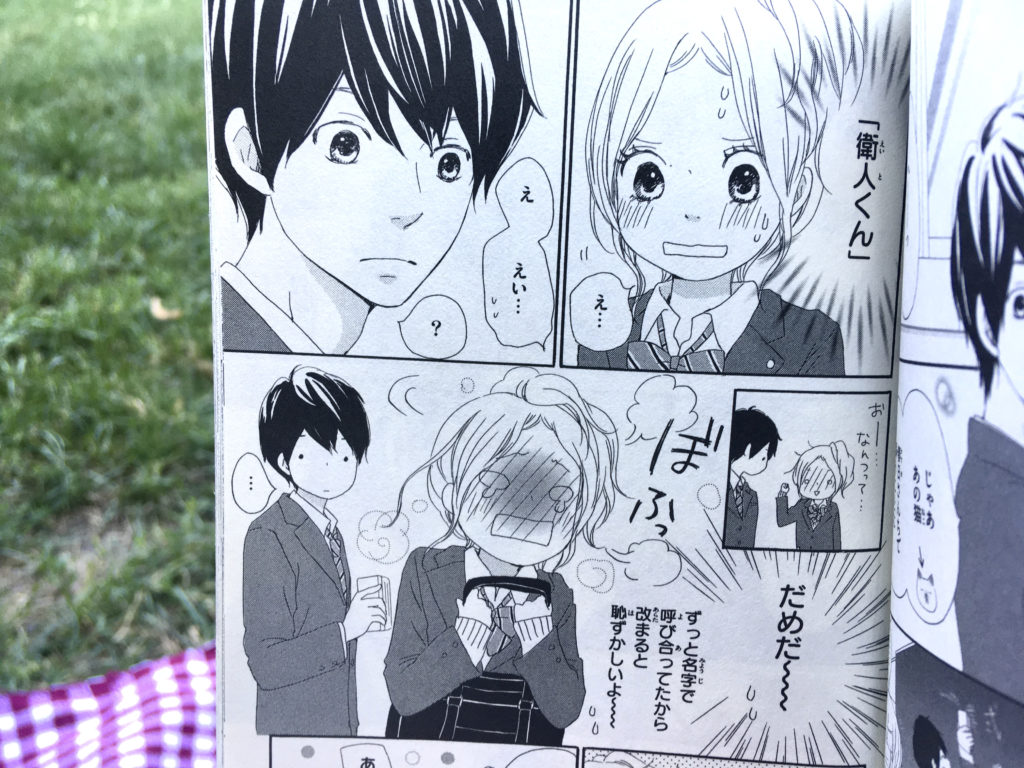
Back to Kokoro Button: In the next chapter, Kasuga-san receives the news that her female classmate has started to be on a first name basis with her boyfriend. Kasuga-san is clearly envious, and when she meets Kōga-kun, she tries to call him by his first name, Eito, but fails. Only “e-” and “ei…” come out. The smart boyfriend gets what she’s trying to do though, and teases her: “And then?”

Kasuga-san struggling at trying to speak her boyfriend’s name, and failing at it. (P. 89)

As for Hayami-kun, it turns out – again, at the climactic end of the chapter – that he had mixed up Kasuga Nīna-san’s names – he thought Nīna was her family name! Despite being a bad boy who tells people off the whole time, the fact that he had called his best friend’s girlfriend by her first name torments him endlessly – so grave was the offence!

Although this particular interaction is not followed up upon, I see the fact that Hayami-kun falls in love with Kasuga-san later on in the manga partly as a result of this early trespassing into her intimate sphere. Once there, he was stuck, sort of thing!

The next level of intimacy

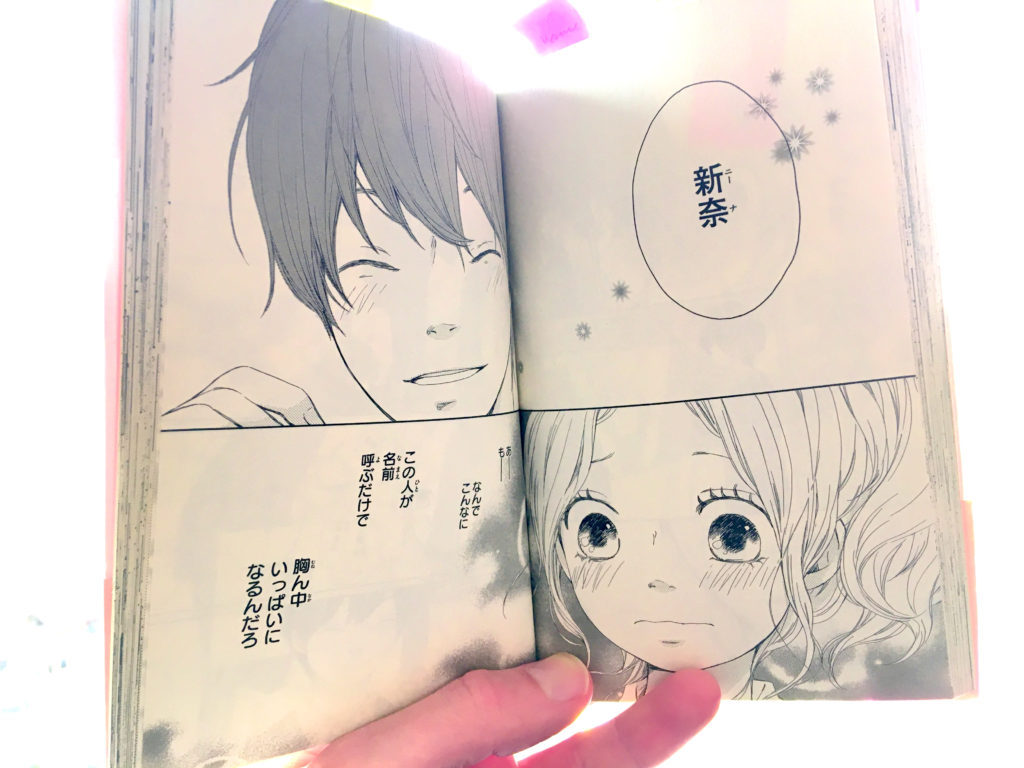
Inspired by Kasuga-san’s failed attempts to call him by his first name, Kōga-kun suggests that he, as her boyfriend, starts calling her by her first name. Kasuga-san is in shock. She blushes. But she wants this. We have been primed with the news of her classmate taking this step with her boyfriend, a step almost as serious as a proposal, it seems. And then he says it:

Nīna
新奈

Kokoro Button, vol. 6, p. 112
Kōga-kun says it: Nīna!

The power of calling your lover by their first name! As a reader I’m as excited as Kasuga-san, who is thinking to herself:

(Gasp!) Why this sudden feeling … This person only spoke my name … And yet my heart is starting to beat … It’s beating faster and faster …

Kokoro Button, vol. 6, p. 113–114

Kōga-kun laughs as he speaks her name, comments that it’s embarrassing for both of them. And then he implies that it’s her turn. Can she call her boyfriend by his first name, Eito?

As it turns out, no. Again, Kasuga-san is like:

E… Ei… Ei…

Kokoro Button, vol. 6, p. 115

And again, Kōga-kun encourages her: “And then?” But to no avail – she can’t say his first name! “I guess it will take some time”, Kōga-kun comments, and the chapter ends.

Forcing her to speak his name

The next chapter begins with Kasuga-san boasting to her female friends (who all call her Nīna), that Kōga-kun has called her by her first name. They congratulate her and Kasuga-san plays coy. “Oh, it’s nothing really.” But we know that it isn’t nothing!

When Kōga-kun appears, she greets him with an excited “Kōga-kun”. When he replies, he addresses her with “Kasuga-san” again. She is surprised. Wasn’t she “Nīna” with Kōga-kun now?

“Ka… ‘Kasuga-san’?”
“That’s right. You’re not calling me by my name, right? So I thought I’ll just return to how it was before.”

Kokoro Button, vol. 6, p. 120

Oh nooo! Kasuga-san is devastated. Kōga-kun seems amused and in the end teases her by calling her “Nīna”-chan. (He’s an “S”, meaning a “sadist” who likes playing with Kasuga-san’s feelings.)

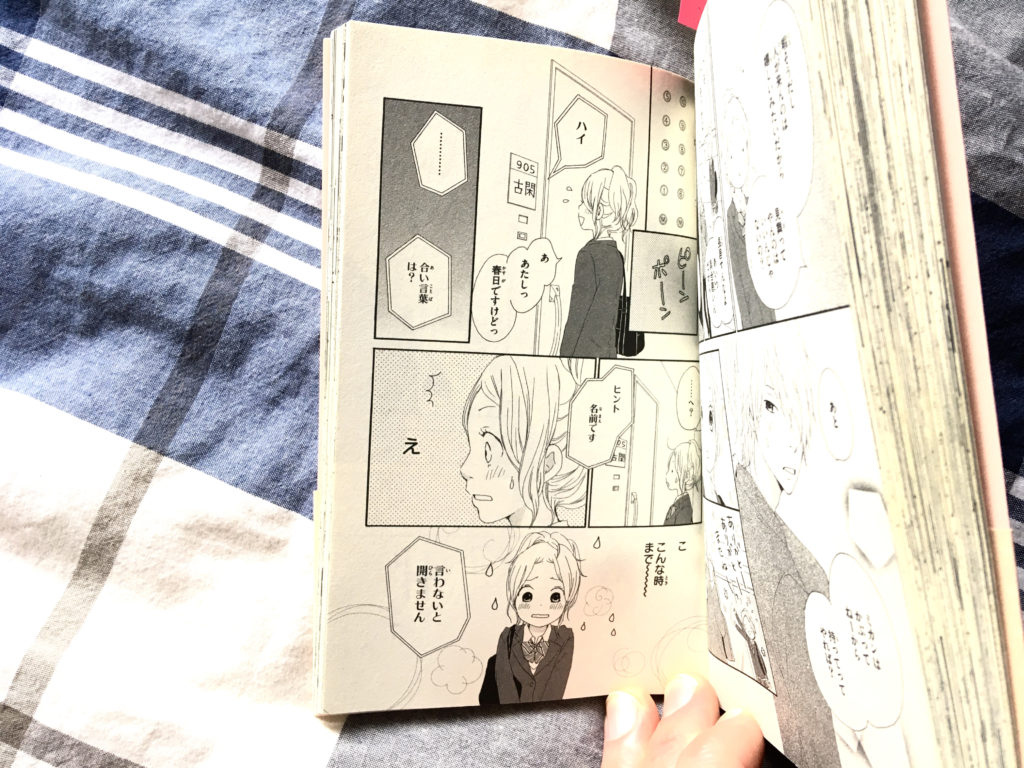
The tension continues throughout the chapter until Kasuga-san is about to visit Kōga-kun, who is home sick. As she calls him from the intercom at the entrance of the house, he replies:

What’s the secret password? I’ll give you a hint: It’s my name. I won’t open until you say it.

Kokoro Button, vol. 6, p. 133

Damn, is this guy cruel or what!

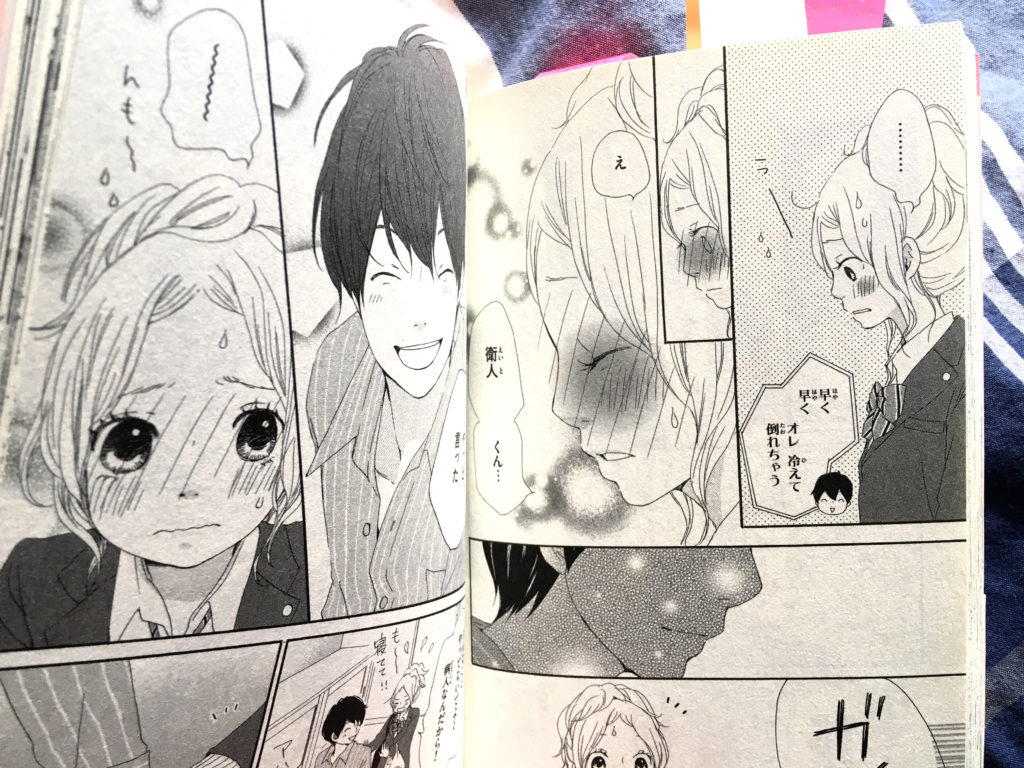
Come on, fast or the fever is gonna make me pass out!

Kasuga-san finally says it!

And so Kasuga-san finally says it, in the security of the intercom (not having to face him eye to eye): “Eito” – but she quickly adds a -kun. Well, that’s good enough for now.

The power of transgressions

As the story proceeds, they both go back to calling each other Kōga-kun and Kasuga-san, but the transgression of calling their date by their first name has been made, and it’s an important act of intimacy that will bind them together for the rest of the series.

As an outsider, I’m fascinated by the importance of what you call your partner, and how this dynamic can power story arcs over several chapters, including cliffhangers and resolutions.

Kokoro Button (ココロ・ボタン) by Usami Maki (宇佐美 真紀) was published in Betsucomi between 2009 and 2013, and concurrently in 12 beautiful tankōbon volumes. The series is translated to German and French.

Get Kokoro Button on Amazon

You can get the Japanese version on Amazon.com, and the German version on Amazon.de. The French version has a page on Amazon.fr, but seems to be sold out.

The links to Amazon are paid links: As an Amazon Associate I earn from qualifying purchases.

Filed Under: Commercial, Essay, Shōjo Tagged With: Kokoro Button, Usami Maki, ココロ・ボタン, 宇佐美 真紀

Gon Freecss in Hunter x Hunter shirtless

Homoerotic symbolism in Hunter × Hunter

2024-05-14 by Karl Leave a Comment

The sexual references are bouncing off the pages as Japan’s favourite manga character Gon has his shōkō popped by a man.

Hunter × Hunter is the ultimate adventure comic. It was created by Togashi Yoshihiro in 1998, and made into an anime twice: In 1999 and 2011. The series is one of Japan’s most popular mainstream manga and anime. With 148 episodes of the 2011 anime so far, the adventure is still ongoing in the manga. Here we will take a closer look at episodes 39 – 44 of the anime from 1999.

The ultimate boy

The protagonist of Hunter × Hunter is Gon Freecss, a good-hearted and high-spirited 12 year old, who in many ways is the ultimate boy – not only because twelve is the perfect age for a shota boy. Gon is on a quest to find his father, who abandoned his family to become a “hunter”, a title and status given only to those who pass certain tests. So Gon sets out to become a hunter himself, figuring an occupation that leads a father to abandon his family must be truly awesome, or else his father wouldn’t have left them.

That’s the backdrop to what eventually leads up to a classic – in the word’s most literal sense – coming-of-age story. This arc plays out in the Celestial Tower, a huge phallic building with hundreds of floors – each one a battleground to conquer in order to reach the top. People spend months and years in the tower, which can be seen not only as a symbol of puberty – the transition from boy to man – but for life in general; each floor, each year is a struggle – a fun struggle.

Gon approaches the tower together with his friend Killua. (The friendship between the two boys is beautiful and full of symbolic hints; much has been written on Gon and Killua being “more than friends”.) They befriend a younger boy, Zushi, and his coach Wing. In order to win matches, the fighters must master nen, a kind of energy which resides inside every human being, but which must be awoken before it can be put to use. If a fighter enters the ring without knowledge of this technique, they are quickly “initiated” by their nen-using opponent, but since it’s a fight, there is malicious intent in this kind of sudden initiation, and it can result in damage or death. Wing is therefore teaching nen to Zushi, so that his protegé can learn to master it in a controlled way before entering the ring.

Wing immediately senses Gon’s and Killua’s natural proclivity for nen, and takes it upon himself to teach the boys how to master it. He has a hard time hiding his excitement about his new pupils to Zushi, whose progress with nen is slow – maybe because he is still too small, whereas Gon and Killua are at the exact right age where this initiation can and should occur in boys.

Sexual innuendo

Technically, nen (念 ≈ “mind force”) is a way for its users to control their own aura. Every person has an energy flow emancipating from their body, and mastering this energy field is key to winning the matches in Heaven’s Arena – the top floor of the Celestial Tower – and to mastering life as a hunter in general.

Symbolically, however, nen is akin to another three letter word with “e” in the middle: Sex. To understand this, we need to take a brief historical look at male coming-of-age rites:

When a boy of the Dorian people of ancient Greece was coming of age, he was given over to the care of a male friend of the family, who over a period of three months would teach the boy everything he needed to know in order to become a man. Learning to hunt was one of the most important parts of this initiation; the theme (and title) of Hunter × Hunter thereby focuses on a fundamental aspect of a boy becoming a man. But another important part of the initiation was the symbolical and literal insertion of manhood into the boy through anal sex; the man had to “inject” the boy with his semen, where the source of manhood was believed to reside, as described by Michel Foucault in the second volume of The History of Sexuality (1985). This practice is echoed almost to the letter by the contemporary tribes described by the anthropologist Gilbert Herdt in Ritualized Homosexuality in Melanesia (1984). It seems that sex between men and boys has been an intuitive feature of male coming-of-age rites in cultures otherwise diverse, and maybe it still lurks in our subconscious?

Popping the tight shōkō

Wing’s initiation of Gon and Killua begins in episode 39 in the 1999 anime. Nen is usually taught for a longer period of time, but since Gon and Killua are rushing to their next match, where they will need nen, Wing decides to transfer his nen, or ki (気 ≈ “energy”), to the boys in a more direct way – by opening their shōkō (精孔). We need not dwell on the exact meaning of this concept, as it is pretty abstract; shōkō basically function as the “nodes” for a person’s “aura”.

“Take off your coats and turn your back towards me”, he instructs the boys, and advises them to focus on their “tightly closed shōkō”.

“Take off your clothes and turn your back towards me!” Hunter x Hunter (1999) episode 39.

He goes on in a way that would make the late Kenneth Dover (author of Greek Homosexuality, 1978) blush:

“I will now pass on my ki into your body in one shot, and open your shōkō.”

Wing explaining how he will “shoot” his “ki” into the boys’ “shōkō”.

Cut to the boys’ nervous and excited faces, as Wing says from behind their backs: “I’m going to begin.”

Wing prepares the boys.

How does a boy feel when the man transfers his manhood to him? What did a boy in ancient Greece think? Were they afraid? Proud? Excited? Gon is thinking this:

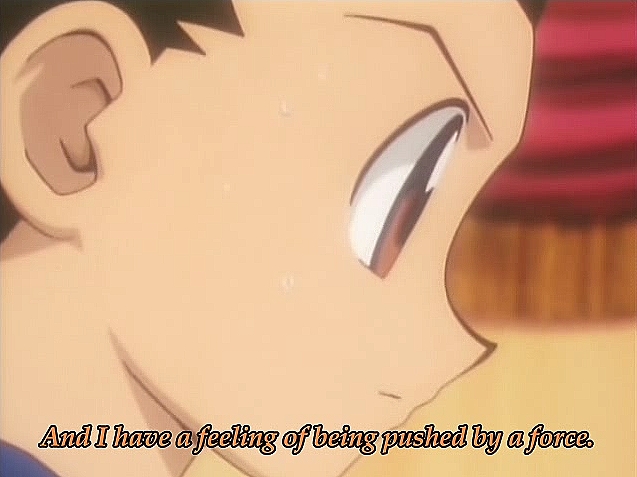
“I feel very hot, and I have a feeling of being pushed by a force.”
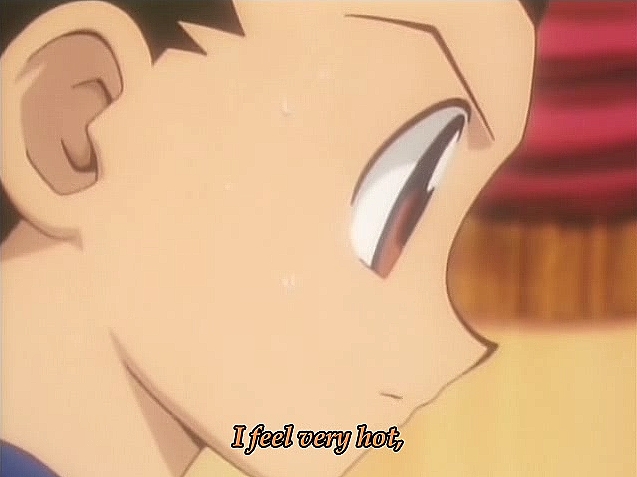
  • Gon in Hunter x Hunter is feeling hot.
  • Gon in Hunter x Hunter is being pushed by a force.
Gon feeling hot as Wing pushes from behind.

Then suddenly, the boys’ eyes wide open, their mouths gasping in shock and amazement.

The moment Wing pops the boys’ shōkōs.

It has happened – the man has transfered his energy – a part of himself – into the boys.

“Now your shōkō have been opened”, Wing concludes.

In the next episode, he reflects: “I may have awoken uncontrollable beasts.”

Comparing loads

Nen consists of many sub-concepts such as gyō, hatsu, ren, so for the next month the boys are busy learning all of them from their sensei. In episode 41, it has become time for the boys to get to know their newly awoken nen more intimately. There are different types of nen (or more specifically hatsu, 発), but you can’t choose for yourself which type you are – your type is as static as your DNA throughout life, a bit like how we think about sexual orientations, or blood types. A test with water and a leaf in a glass reveals which type you are.

Wing shows the boys how it is done:

“Hold your hands close to the cup and release your ren.”

Getting ready for the circle ren.

In Wing’s case, the water starts overflowing the cup, which means he belongs to the “reinforcement” type of hatsu. Then it’s the boys’ turn. Gon’s aura too causes the water to overflow the cup – he too is a reinforcer. For little Zushi, the leaf starts moving – it means he’s a “manipulator”. But for Killua, nothing happens, and he is disappointed at first. But Wing instructs him to taste the content of the cup into which he has released his ren. Gon and Killua stick their fingers into the liquid and moves them to their mouths, taking a lick:

“It’s a little sweet.”

Gon tastes Killua’s sweet release.

The water changing taste means Killua belongs to the “transformation” group.

The whole scene brings to mind the cup-bearers of ancient cultures, the sweet or overflowing liquid of course being a symbol of the boys’ own unique liquid DNA: Sperm. One of the personality types revealed by the water test is even called “emitter” (hōshutsu, 放出). The excellent Fandom page on Nen explains:

An affinity for Emission (放出系, Hōshutsu-kei; abbrev. as 放) means that a user has an easier time separating their aura from their body.

A person’s aura is a person’s soul, an abstract concept that in our scientific times can be said to reside in a person’s DNA, which is literally emitted through ejaculation.

Gay Hisoka

The main reason why Gon wants to master nen is because he wants to fight Hisoka, a flamboyant Pierrot and fellow hunter candidate. Hisoka’s interest in Gon has been expressed very explicitly throughout the series. He talks about wanting the fruit to ripe before he picks it. He is obviously the “gay” character of the series, but not in a negative way – Hisoka is portrayed as the most powerful (and dangerous) of the hunter candidates. Since Gon too is a wunderkind of sorts, this binds them together. Hisoka is very smart and relies on advanced magic in his fights. Gon, on the other hand, is a bit dumb but has an extremely good smelling sense; his intelligence works on a more intuitive level. Hisoka, who belongs to the transformation group, concludes: “Opposites attract.”

Hisoka is attracted to Gon.

After the water test, Gon seeks out Wing again to show him “his results so far”. The water overflows again and Wing expresses his admiration for the boy’s development. Yet he knows, or fears, why the boy really came to him, and the ensuing dialogue has a subtle intensity that we are used to from heterosexual love dramas:

“You want to fight Hisoka”, Wing says with his back turned towards Gon. “Am I right?”

Gon confirms, and Wing turns around to face him:

“I’m only a person who teaches you nen. I don’t have the right to decide how you should live. I agree to your fight with Hisoka.”

And so, the boy is free to leave the man who introduced him to nen, and go out in the world to practice it in his own life, with the people he choose.

Overt man/boy eroticism

Let the game begin: Gon vs Hisoka.

“Both participants have looked forward to this match. Does that mean there is a special connection between them?” the female commentator says in the microphone as the match is about to start.

Hisoka is thinking: “Don’t look at me like that. The eyes you use to look at me are full of passion.” As he is thinking this, his arm straightens out on its own. “This makes me excited”, Hisoka says to himself as his straight arm starts pointing upwards despite he tries to keep it down with his other hand. “Even more excited!” he exclaims as the arm reaches full erection – the allusion to an erect penis is obvious and humorous.

Gon’s intense look gives Hisoka an arm erection.

Killua in the audience thinks to himself as they start fighting, with the vastly superior Hisoka scoring the first point without even moving: “Hisoka looks like he’s in ecstasy. But Gon looks like he’s having fun too, even though he has been punched hard.”

“I finally hit Hisoka”, Gon happily remarks as he scores his first point; Hisoka turns his bruised face towards the boy and smiles.

Gon gets a facial

As the real fight between the two begins, Hisoka squirts out his magic “pansy gum”, a whiteish, semi-transparent lash of energy, into Gon’s face, where it gets stuck on his chin and lets Hisoka control him:

“You will never be able to escape me again. … You will never be able to escape from my flexible pansy gum.”

Hisoka has given Gon a facial.

But the fight suddenly turns around and Gon manages to repeatedly hit and kick Hisoka hard. Hisoka is thinking between the blows:

“Gon … Great … this is great! Your eyes, your expression, and your spirit … Right now, I want to … destroy you. But not yet. I’ll wait … until the fruit is ripe. It’ll be such a pity if I destroy you now. I’ll wait till the wait piles up higher and higher. I have to endure … endure … endure!”

Hisoka is obsessed by Gon.

The obvious references to sex and love almost takes the fun out of the analysis. Let’s just conclude that the Hunter × Hunter watchers get a hefty dose of man/boy intimacy every time Hisoka and Gon appear on stage together. If anyone still doubts this, the next cut lets us watch Hisoka in the nude as he’s taking a shower after the match.

“It’s good that I’ve found new toys to play with”, he comments as we get to see a shot of Gon and Killua. “It’s time to find the prey …”

Hunters know nen, men know sex

Episode 43 opens with the water test, this time the final exam. Gon’s hands around the cup, with the phallic Celestial Tower in the background. The water overflows. Killua’s turn, we know what will happen by now. He lets Gon and Zushi taste the content of the cup:

“It almost tastes like honey”, Gon says. Yummy!

After some more matches, the arc closes with Wing telling Gon and Killua that they have now mastered nen, and that they thereby have passed the secret hunter exam:

“Knowledge of nen is the basic requirement for a hunter.”

The initiation from candidate to hunter, from boy to man, is over, and the message between the lines is clear:

“Knowledge of sex is the basic requirement for a man.”

Wing goes on to explain that the secret exam of mastering nen doesn’t have a predetermined path:

“It doesn’t matter if you’re willing, as long as you’ve passed the exam, you will one day feel the existence of nen. It’s coincidence, or fate, that you two came to Celestial Tower and met me.”

After spending four months together – very close to the three months of the Dorians – the boys and the man part. They do so in the sunset, against the backdrop of the phallic tower and a thick rug of romantic violins.

The boys have become men and part from their teacher, phallic tower in the background. (Little Zushi on the right is not ready yet, he’s still a child.)

The boys’ new status as nen users is confirmed in some comical interactions with women at the end of the episode. Killua makes fun of the elevator girl. Gon is shocked by Killua’s teasing and tells him to stop, but Killua replies:

“It’s okay. Don’t forget, we’re nen users now. We shouldn’t be afraid of her no matter how strong this woman is.”

So mastering nen changed the boys’ attitude toward women; instead of being boys in relation to women, they are now men. But it turns out the woman is a nen user too, and as Gon and Killua leave the elevator, they have bruises all over their faces – apparently a fight had broken out between the three nen users. It’s not without sorrow that we conclude that the boys just got their first bite of adulthood.

Eroticism at work

This is my reading of Hunter x Hunter. The erotic undertones happen (mostly) on the subconscious level on both the producing side (creator, editor, publisher) and among the consumers (readers and viewers). Of course there are also intended sexual references: Producers use “fan service” to give the fans “what they want” in terms of sexual desire for the characters, and consumers use “shipping” to pair up their favourite characters in romantic and sexual unions. But these are just droplets of desire compared to the male eroticism that is the very fundament of boys’ manga, a kind of inexhaustible source that keeps guaranteeing their success as new generations of boys want to become men.

Hunter × Hunter (2011) is available subtitled at services like Netflix, Hulu, and Crunchyroll.

Liked this? Read my other takes on eroticism in mainstream manga:
  • Jumbor and the eroticism of mainstream boys’ manga
  • Man/boy romance in Full Ahead! Coco
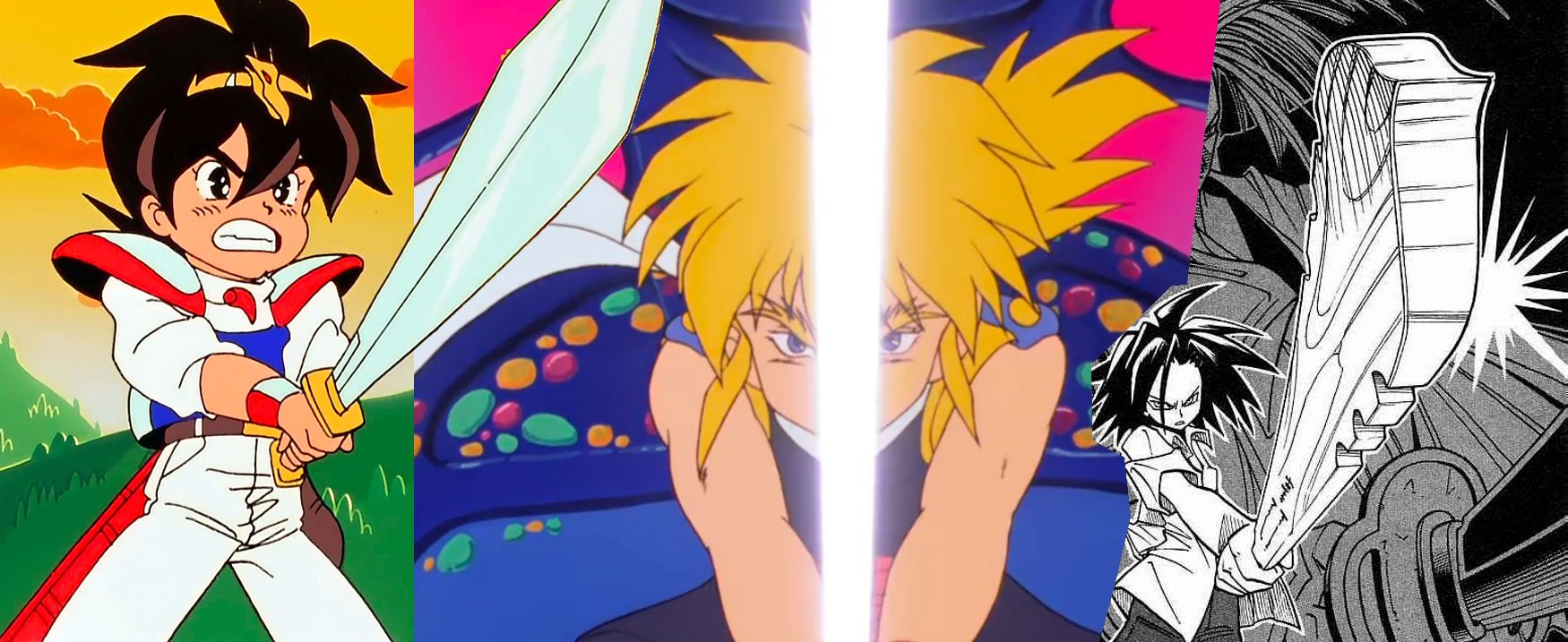
  • Young boys with big swords – phallic symbolism in Wataru and Shaman King

Filed Under: Anime, Commercial, Essay Tagged With: boy eroticism, Gon, Hunter x Hunter

ショタコンのゆりかご

2024-05-10 by Karl Leave a Comment

In ショタコンのゆりかご (shotacon no yurikago = “the cradle of shotacon”), shota expert Budōuri Kusuko (interviewed in 腐男子にきく) traces the origins of the manga genre shotacon. His focus is commercial shota magazines rather than dōjinshi.

The essay begins with a richly referenced study (first published in October 2006) into the etymology of the word shotacon, which partly relies on Watanabe Yumiko’s essay ショタの研究 (shota no kenkyū = “shota research”).

The second chapter describes “the development of shota expressions” in the 1990s, and the third chapter documents a temporary decline in the genre in the late 1990s.

The fourth and last chapter (first published in September 2007) is devoted to the development of commercial shota publications in the first years of this millennium (up until when Budōuri-san wrote his essay).

ショタコンのゆりかご is an excellent resource that provides important historical data to shota research.

A 10 page appendix with data on shota titles accompanies this essay.

An English summary of Budōuri’s findings can be found here:

The rise and fall of commercial shota magazines

Filed Under: Dōjinshi, Research

My own shota

My own shota

2024-04-15 by Karl Leave a Comment

Eric was hot. He had a rough edge, because he was a city boy and his parents were divorced. He had a moped. He had longish hair and lips that pouted just slightly and gave him a simple look. He probably wore braces, I don’t remember. But despite his rough aura, Eric was also kind. He didn’t hang out with the “cool” boys from the city, but he was respected by them. He was friends with the farmers, and since I was closer to the farmers (the only ones who would accept me), Eric was in my vicinity every now and then.

Eric was my classmate for three years in middle school. I don’t know anything about him either before or after, but for those three years I watched him every week in the changing room at gym class. He changed in the part of the changing room where I and the farmers changed.

My middle school changing room, or junior high school locker room for you Americans, but it didn’t have lockers.

I remember clearly when I watched him undress the first time. His muscles! Despite we were the same age – 12 or 13 years old – the muscles on Eric’s arms were bulging like smooth, toppy hills that disappeared in deep rivers that led into his dark armpit. I was mesmerised by that image, forever imprinted in my mind. I remember the intricacies of that dark pit of raw desire – it was like a mystery to me!

My sketch of Eric in the middle school changing room, as I carry the image with me.

Of course I also remember his penis. It was pointy; stood out a bit from the body, as if it was always slightly erect. A small patch of pubic hair just above it. Over those three years I watched his penis grow: In 9th grade it had the same form – pointy – but was now several sizes bigger. More hair grew on top of it. His muscles had also grown, an intoxicating mess of smooth hills and dark, dangerous rivers. And he had grown underarm hair.

On one of the last days of seventh or eight grade, our teacher asked us what we would do over summer break – would we have a summer job maybe? Eric said he would work at the local saw. “So it’s a muscular Eric who will come back after summer break”, the teacher replied, and I read some desire into her words, like, did she have to mention his body? I still remember this occasion because I thought about Eric and his muscles.

I think I was in love with Eric, but I didn’t realise it, and I’ve never really thought about it after either. At one time the two of us were to go together to a field or forest for an exercise day a bit away from the school. I don’t know how we ended up together, we might have been assigned something, so the others had gone before us. I came to school with the school bus, but Eric had a moped, so he offered me a ride. I did have a moped too, but maybe only later on. I had in any case never sat behind a boy, a sexy boy, on a moped before. I was excited. Where should I hold my hands? There was some kind of metal structure for packages behind the long seat, so I grabbed it behind my back. Eric said: “You can hold on to me.” I didn’t. I thought it would be gay. How I regret that I didn’t, to this day! But I remember the heat from his body under his flannel shirt, flapping in the wind as we rode through the city to the others. I was so much in love!

I don’t have many more memories of Eric. I’ve googled him over the years, but fortunately never seen a picture. He remains in my mind as the perfect 13-year-old boy who I watched naked in the changing room every week for three years. Eric and his muscles. Eric and his penis. Eric and his warm body next to mine on the moped. Eric is my own shota.

Listen up, you reader! You probably carry your own shota with you from when you grew up. Tell me about him! Draw him! And be part of the collective research project into shota and shotacon that will contribute important insights about desire and sexuality to academia. Get in touch, let’s chat, let’s share our imaginations! Fill in the shota survey and let’s take it from there. I want to talk to you!

Filed Under: Personal, Research, Survey Tagged With: drawing, shota

国際おたく大学―1998年:最前線からの研究報告

2024-04-03 by Leave a Comment

This anthology, edited by Okada Toshio, contains the essay “Shota research” (ショタの研究) by Watanabe Yumiko (渡辺 由美子), under the section “Otaku Sexuality 1” (おたくのセクシュアリティ1).

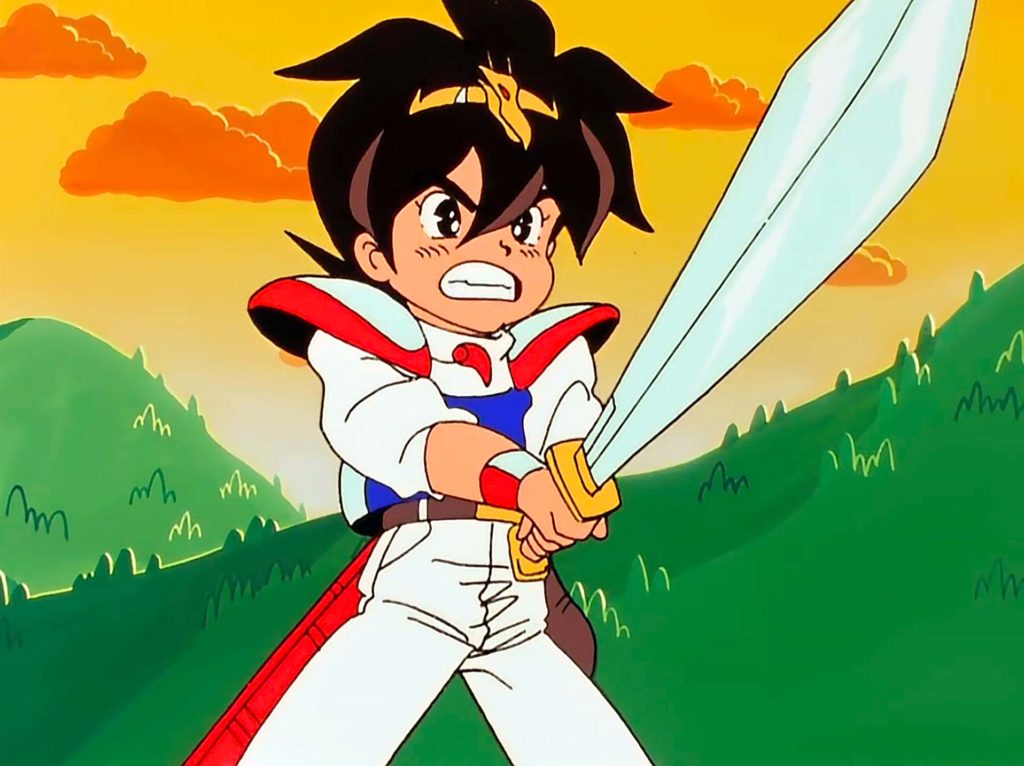
Watanabe-san’s essay is unique in that it interrogates female and male shota fans in the 1990s, while outlining the history of shota aesthetics, as well as providing an analysis of shota’s allure. I read it in great detail and used it as a springboard to watch several key animes from the 1980s and 1990s, “Mashin Eiyūden Wataru” being the most important of them.

Part 1: The history and definition of shota (p. 32-41)

Regarding the etymology of shota and shotacon, Watanabe-san mentions that there were several terms used within shōjo and shōnen-ai manga, including “ribocon” for “little boy complex”, but that the dōjinshi world eventually settled for the better sounding term “shotacon”, which first appeared in a 1981 issue of Fanroad.

Footnote 2 describes how Animecku’s editor Komaki Masanobu (小牧雅伸) and Fanroad’s editor Hamamatsu Katsuki (浜松克樹), pen name “イニシャルビスケットのK”, came up with the term. It was the lolicon boom in the early 1980s and they wondered what a male equivalent would be, for “boys in shorts” (半ズボンの少年). After Komaki dropped the hint of Kaneda Shōtarō (金田正太郎) from Tetsujin 28-gō (the original manga, not the remake which was broadcast at the time), the editors decided to call it “Shōtarō complex”, which became “shotacon”.

Watanabe-san goes on to describe how a number of mainstream boys’ anime, most importantly the “shota trigger” Mashin Hero Wataru (魔神英雄伝ワタル, Mashin Eiyūden Wataru) from 1988, awakened the “shota mind” and established shota as a new genre, separate from yaoi, among dōjinshi creators. I have summarised this development in a separate post:

Wataru and the birth of shota in mainstream anime

As for shota’s definition and age range, Watanabe-san writes that there might be as many opinions as there are shota fans. However, a shota character’s face should not have adult length, and the character must possess some kind of cuteness.

When it comes to shota characters’ personality, Watanabe-san has created a “shota gauge” (ショタゲージ), or “shotameter” in my translation, where she places the qualities “hot-blooded” vs “cool”, and “shorts” vs “skirt” on two continuums, in which she places the popular boy characters from mainstream manga and anime.

Part 2: Female shota fans (p. 42-47)

This section is a conversation between Watanabe-san and X-Kids mangaka Suō-san, who started out creating aniparo dōjinshi in high school. Starting out with Yuu☆Yuu☆Hakusho and Gundam W, both popular among aniparo creators, her taste turned towards shota with Shinji from Neon Genesis Evangelion (新世紀エヴァンゲリオン, 1995):

I didn’t think of him as shota until episode 24 when Kaworu appears, and I was like ‘What, is Shinji like that?!’. (laugh)

Suō-san

Episode 24 of Evangelion spurred a Kaworu ✕ Shinji boom among female creators, both in yaoi and shota. Kaworu’s arrival made fans realise that Shinji was a “total uke”.

Survey results from commercial shota magazines for women show that age difference, as in older/younger brother or even father/son, is the most appreciated feature among female readers. However, shota is much less strict than yaoi when it comes to the seme/uke division. If yaoi was a way for women to escape the uke role to become a seme with the power to “attack” male characters, shota is a whole different “playground” which much more open possibilities, Watanabe-san argues.

Part 3: Male shota fans (p. 48-54)

Watanabe-san begins with explaining how male shota interest emerged from the loli boom in the 1980s. Since the characteristics of loli are smooth, flat chests, and the cute style of shōjo manga, the step was not far to smooth boys. The yaoi boom made it easier for loli mangakas and publishers to experiment with boy characters, which made their ways into loli magazines like Lemon People (レモンピープル) and Hot Milk (ホットミルク). Surveys confirmed that the male readers liked “boy stuff” (少年もの). Eventually the main shota genre “big sister and me” (お姉さんと僕) emerged from this.

Watanabe-san now turns to interview Usagi-no-Tokei-san and Hakuo-san from the shota circle Shiro-usagi, and they claim to not “come from loli”:

At least, we are not shota who came from loli. Both of us were shotacons already in elementary school.

Hakuo-san

They explain how they watched robot animes as children and how they attracted to the boy heroes of animes like Triton of the Sea (海のトリトン) and Babel II (バビル二世), not to mention Kappei of Invincible Super Man Zambot 3 and Amuro of Gundam.

The most appealing thing in boys’ anime is hot friendships. When boys’ friendships are depicted in anime, it moves me and it makes me think of “something” beyond friendship. That “something” is not just friendship or affection.

Hakuo-san

Usagi-no-Tokei-san explains how he experienced “pseudo-love” between boys in elementary and middle school, and how he “got stuck in that stage” when other moved on to male-female relations. He thinks that “staying in the boy stage” is something that shotacons may have in common.

Next, Usagi-no-Tokei-san distinguishes this personal trajectory from that of shota fans who come from loli:

For people who come from loli-kei, as long as it’s smooth (tsurupeta) and cute, a boy too is okay, they seem to reason. Because only the lower body differs (laugh). Therefore they focus on the sex in their shota manga, whereas we who have been shota fans for a long time, for us the boy’s attraction is a much more special thing. That’s how I think about it.”

Usagi-no-Tokei-san

They call their thing “genuine shota” (真性ショタ), and say that there might be more of them than expected. They have set up a website where they collect impressions from other shotacons. They hope that people who find the website might feel relief that they are not the only ones with those feelings. Usagi-no-Tokei-san says that before they found fellow shotacons, they thought they were sick. Interesting here is that the Japanese word shinsei (真性) is also translated as “inborn nature”, and the literal meaning of the kanji is something along the lines of “true sex/sexuality”.

As for their relation to real (actual) boys, they keep a distance and talk about a “compromise” (割り切り). I understand this as a way to rationalise one’s inclination, “I’m ok, I’m not bad”, sort of. Hakuo-san likes 2D only, whereas Usagi-no-Tokei-san likes “2D Plus” (二次元プラス), in that he enjoys watching real (actual) boys, but that is where he draws the border.

Watanabe-san seems very surprised by the mindset of these “genuine” shota fans. She felt a strong sense of “shame”, which is non-existent for female creators who draw yaoi or loli. She observes that shota is drawn differently by men and women. In male shota, not only the seme but also the uke expresses emotions. The reason might be that male shota fans can identify with any boy character they like.

Watanabe-san mentions the recent (that is, recent in 1998) trend of youth ✕ boy (青年 ✕ 少年) couplings, which Usagi-no-Tokei-san exclaims would be “impossible”. Impossible is exactly what makes it good, Watanabe-san argues (with a laugh), and Usagi-no-Tokei-san replies:

(Laugh) I’m more like … Both when I look at shota manga and when I draw it, I immerse myself in that situation, they are not other people to me. If there is a relation between two boys, I too can feel like a boy, but if it’s a youth who does what he wants with a child, that’s a crime. It’s obscene, no matter how much 2D it is …

Usagi-no-Tokei-san

Watanabe-san concludes that for “genuine” shotacons, the boy character is used for self-identification, and that they through shota might be chasing the “imaginative boys” of their own past.

Finally, there is a discussion on homosexuality and how discrimination made it hard to say that you are attracted to your own sex, which I suppose the “genuine” shotacons are? If the word “homosexuality” was not so loaded, liking boys would be just another hobby, like “sabu-kei” (さぶ系) or “shemales” (ニューハーフ), Watanabe-san writes.

In the end, whether people are accepted or not depends on the ‘words’, as conceptual rules, that are attached to them. The fact that we have started to come out little by little is thanks to the word “shota”. I’m a shota, I’m an otaku, whatever the genre, the words attached to people do not only discriminate, but also have positive meaning, which leads to a feeling of acceptance.

Hakuo-san

Watanabe-san concludes that since “shota” is a word that spread from inside out, and wasn’t used by outsiders to discriminate, it can be used to accept, empower, and express oneself.

In the last section, Watanabe-san describes what she calls “borderless gender transformation” (性ボーダレス化):

Men turn from loli to shota, women turn to loli, in the shota world phenomena like “female Shinji” appear, whatever, whenever can be meshed together.

Watanabe Kumiko-san

However, my impression is that the “genuine” shota fans are not included in that optimistic analysis. Even so, Watanabe-san’s interview with Hakuo-san and Usagi-no-Tokei-san is indeed groundbreaking, and a great stepping stone for further research into shota and its readers.

Filed Under: Anthology, Book, Research Tagged With: shota

腐男子にきく。

2024-03-28 by Leave a Comment

This is the first study of “fudanshi” (腐男子), or “rotten boys”, originally published as a dōjinshi in 2008 by Yoshimoto Taimatsu. The term “fujoshi” (腐女子), or “rotten girls”, for women with a strong interest in BL and yaoi gained attention in 2006. Taimatsu-san turned his focus to male readers of BL and yaoi. In the words of Nagaike Kazumi:

In 2008, another male fan and critic of BL, Yoshimoto Taimatsu, self-published a study, Interviewing Fudanshi (Fudanshi ni kiku) in an initial attempt, by means of an innovative analysis of heterosexual male readings of BL, to make heterosexual male readers of BL (i.e., fudanshi or “rotten boys”) visible for the first time.

Nagaike, Kazumi. 2015. “Do Heterosexual Men Dream of Homosexual Men? BL Fudanshi and Discourse on Male Feminization.” In Boys Love Manga and Beyond: History, Culture, and Community in Japan, edited by Mark McLelland, Kazumi Nagaike, Katsuhiko Suganuma, and James Welker, 189–209. Jackson: University Press of Mississippi.

Taimatsu-san comments in the preface that the common image of straight men is that they are uninterested in, and sometimes hostile towards, homosexual imagery. Fudanshi obviously break with this homophobic tradition:

これまで男性は、同性愛者でない限り、同性愛は嫌いなのが当たり前と考えられてきた。 同性愛者は「近寄るな」と遠ざけられるか、 いいところネタとして、笑いの対象になるのがせいぜいだった。しかし「腐男子」は、嬉々 として男性同士の恋愛を楽しんでいる。いっ たい彼らはどのような性志向を持っているの だろうか?

Of particular interest is the interview with BL and shota expert Budouuri XQO-san (葡萄瓜さん), who has bought shota material “in realtime” since their appearance around 1991. Among other things, the two discuss how BL became a refuge for (straight) men who felt opressed in terms of love and sex during the bubble years, and how those men deal with the fact that the content is “homo”. As for shota research, they emphasise the importance of looking at reader letters in shota magazines.

Budouuri-san and Taimatsu-san discuss the allure of shota, and I want to quote from the interview here:

T: ただ、ショタには惹かれるものがあった のですよね。
B: ありましたね。男の子同士のふれあいは、 異性とのふれあいと少し違うかな、と言う感 覚がありました。
T: やっぱり男の子同士が一番いい、と感じ られていたのですか。
B: あくまでも男の子同士のふれあい、つながりの気分ですね。その表現としてエロもあ りと言うことで。
T: セックス先にありき、では無いわけです ね、一貫して。
B: 無いですね。

I think Fudanshi ni kiku is a unique contribution to this field, and I look forward to digging deeper into it.

Filed Under: Dōjinshi, Research Tagged With: BL, fudanshi, research, shota

  • 1
  • 2
  • 3
  • …
  • 5
  • Next Page »

My book about shota

https://www.youtube.com/watch?v=jBsDoCIyfiY
Shota Newsletter!
Join your shota friends – get notified of new posts and receive something extra in between.
No spam, unsubscribe at any time.

Book recommendations

You can find several of the books I refer to on this site on Amazon. As an Amazon Associate I earn from qualifying purchases if you use these links:

Shaman KingTakei Hiroyuki: Shaman King, vol 1–3. Takei-sensei is my favorite character designer, and if you start reading Shaman King, you’ll understand why. Available in English on Amazon.com, Amazon.ca, Amazon.co.uk.

Nagayama Kaoru: Erotic Comics in JapanNagayama Kaoru: Erotic Comics in Japan. The classic book about eromanga which both tells its history and discusses its contemporary status in Japan. Find it on Amazon.com, Amazon.co.uk, Amazon.ca, Amazon.de. (See my review here.)

Kimi Rito: The History of Hentai MangaKimi Rito: The History of Hentai Manga. The perfect complement to Nagayama’s introduction. Explores the expressions in Japanese eromanga. Find it on Amazon.com, Amazon.co.uk, Amazon.ca.

Recent posts

Kokoro Button: Kasuga-san and Kōga-kun! ココロ・ボタン

Call me by my first name: Intimate transgressions in Kokoro Button

2024-05-31

Gon Freecss in Hunter x Hunter shirtless

Homoerotic symbolism in Hunter × Hunter

2024-05-14

My own shota

My own shota

2024-04-15

What are little boys made of?

The Ontology of the Boy, or: What are little boys made of?

2024-03-27

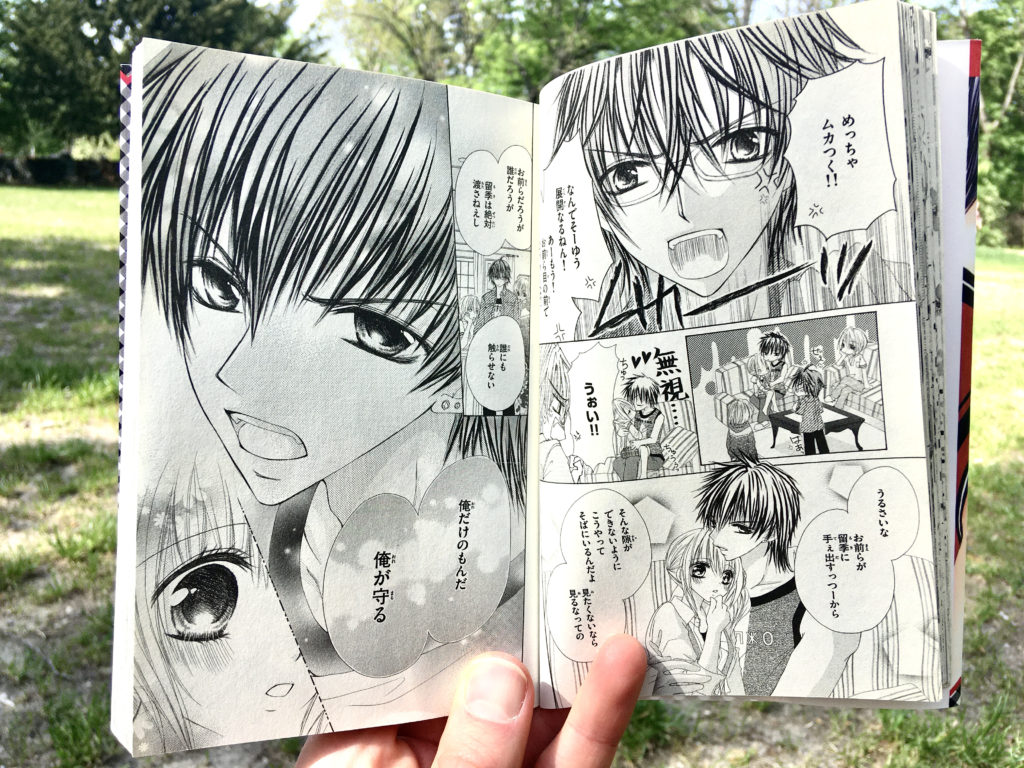
Gokujō danshi to kurashitemasu 2

Honour culture and fictional fiction in “Help, I can’t resist the super sexy boys I’m forced to live with!”

2024-03-14

Boys with swords: Wataru, Toraoh, Yoh-kun

Young boys with big swords – phallic symbolism in Wataru and Shaman King

2024-02-23

3D shota boys

Survey: Do you like 3D shota? (3DCGショタが好きですか)

2024-02-18

Full Ahead! Coco, volume 15, cover art

Man/boy romance in Full Ahead! Coco

2024-02-02

Jumbor Angzengbang 2, ユンボル 1, manga cover art

Jumbor and the eroticism of mainstream boys’ manga

2023-12-22

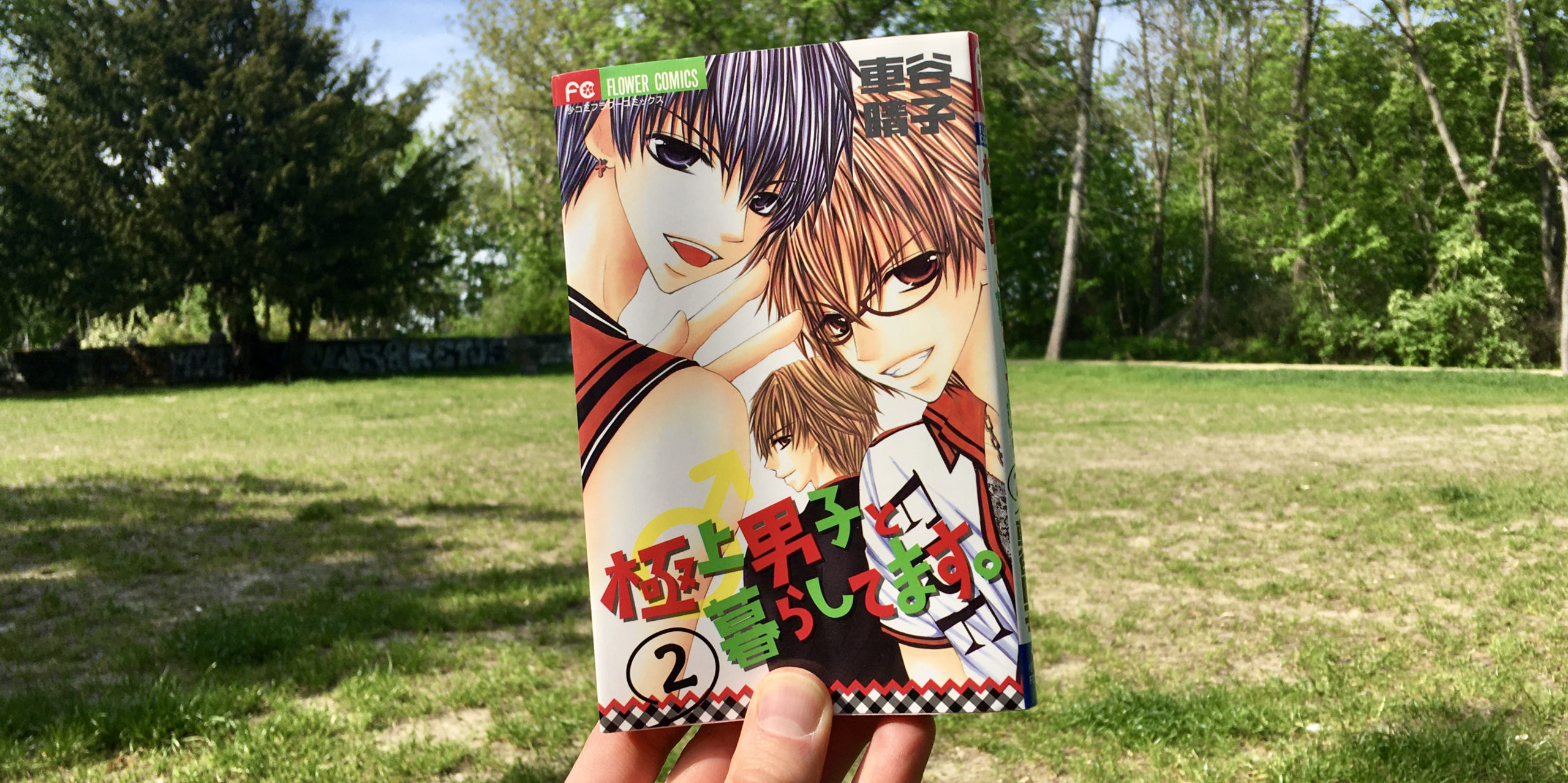
車谷晴子:「極上男子と暮らしてます。」(2007)

Real shota in “Yay, I’m living with a super sexy boy!”

2023-09-22

Reference library

ショタコンのゆりかご (book cover)

ショタコンのゆりかご

Author: ぶどううり くすこ

An essay on the origins of shota, published as a dōjinshi.

国際おたく大学―1998年 最前線からの研究報告

国際おたく大学―1998年:最前線からの研究報告

Authors: 岡田 斗司夫, 渡辺 由美子

An anthology on “otakuology” that contains Watanabe Yumiko’s important shota study.

吉本たいまつ:腐男子にきく。

腐男子にきく。

Author: 吉本 たいまつ

An interview study on male fans of BL and yaoi, published as a dōjinshi.

The Syotaroh by まんだ 林檎

The Syotaroh

Author: まんだ 林檎

An impressive work on the early shota subculture.

エロマンガ・スタディーズ

Erotic Comics in Japan

Author: 永山 薫

One of the main resources on adult manga.

ショタリポート①

ショタリポート①

The first part of an interview study of shota fans.

  • X

About This Site

This may be a good place to introduce yourself and your site or include some credits.

Meta

  • Log in
  • Entries feed
  • Comments feed
  • WordPress.org